Leta i den här bloggen


Visar inlägg med etikett PRYSPRY). Visa alla inlägg

lördag 5 maj 2018

TRIM17(Kr.1q42.13) RNF16, RBCC (C_IV,PRYSPRY), Solunjakaantumisen jätekäsitelyä

TRIM17 (Kr.1q42.13)

Tämän TRIM17 rakenteeseen kuuluu RING, Bbox1 , Bbox2 ja Coiled-Coil domaanit. Proteiini lokalisoituu sytoplasmakappaleisiin. Proteiinia ilmenee miltei yksinomaan testiksessä ja  funktio oli tuntematon vielä 2008. Monia vaihtoehtoisia transkripteja pleissautuu. Geeniä ilmenee myös pernassa ja 11 muussa kudoksessa. Viime vuosien löytöjä TRIM17:n funktiosta on sen osallistuminen solunjakautumisen koneiston jäteproteiinien degradaatioon, nämä jäänteet ovat tunnettuja autofagian kohteena olevia proteiineja. Monet alternatiivisti pleissautuvat variantit saattavat tehostaa tällaista funktiota. TRIM17 osallistuu myös neuronaaliseen apotoosiin vuorovaikuttamalla NFATc3 resiprokaaliseen säätelyyn.8Tästä on mainitaa aiemin)
  • https://www.ncbi.nlm.nih.gov/gene/51127
  • Also known as RBCC; terf; RNF16. Summary The protein encoded by this gene is a member of the tripartite motif (TRIM) family. The TRIM motif includes three zinc-binding domains, a RING, a B-box type 1 and a B-box type 2, and a coiled-coil region. The protein localizes to cytoplasmic bodies. The protein is expressed almost exclusively in the testis, but its function is unknown. Multiple alternatively spliced transcript variants have been found for this gene. [provided by RefSeq, Jul 2008] Expression Biased expression in testis (RPKM 5.7), spleen (RPKM 1.3) and 11 other tissues See more

Rakenteesta. Konservoidut domeenit.

Conserved Domains (3) summary
cd00021
Location:97 → 134
BBOX; B-Box-type zinc finger; zinc binding domain (CHC3H2); often present in combination with other motifs, like RING zinc finger, NHL motif, coiled-coil or RFP domain in functionally unrelated proteins, most likely mediating protein-protein interaction.
cd15812
Location:296 → 472
SPRY_PRY_TRIM17; PRY/SPRY domain of tripartite motif-binding protein 17 (TRIM17), also known as testis RING finger protein (terf)
RING-HC_TRIM17_C-IV; RING finger, HC subclass, found in tripartite motif-containing protein TRIM17 and similar proteins
Location:13 → 66


Rakenne, isoformi 1

GenPept
E3 ubiquitin-protein ligase TRIM17 isoform 1 [Homo sapiens]
NCBI Reference Sequence: NP_001020111.1
Identical Proteins FASTA Graphics
LOCUS       NP_001020111             477 aa            linear   PRI 11-FEB-2018
DEFINITION  E3 ubiquitin-protein ligase TRIM17 isoform 1 [Homo sapiens].
ACCESSION   NP_001020111
VERSION     NP_001020111.1
DBSOURCE    REFSEQ: accession NM_001024940.2
KEYWORDS    RefSeq.
SOURCE      Homo sapiens (human)
  ORGANISM  Homo sapiens
            Eukaryota; Metazoa; Chordata; Craniata; Vertebrata; Euteleostomi;
            Mammalia; Eutheria; Euarchontoglires; Primates; Haplorrhini;
            Catarrhini; Hominidae; Homo.
REFERENCE   1  (residues 1 to 477)
  AUTHORS   Mandell MA, Jain A, Kumar S, Castleman MJ, Anwar T, Eskelinen EL,
            Johansen T, Prekeris R and Deretic V.
  TITLE     TRIM17 contributes to autophagy of midbodies while actively sparing
            other targets from degradation
  JOURNAL   J. Cell. Sci. 129 (19), 3562-3573 (2016)
   PUBMED   27562068
  REMARK    GeneRIF: TRIM17 promoted the removal of midbodies, remnants of the
            cell division machinery that are known autophagy targets.
            Erratum:[J Cell Sci. 2017 Mar 15;130(6):1194. PMID: 28298613]
REFERENCE   2  (residues 1 to 477)
  AUTHORS   Yang X, Coulombe-Huntington J, Kang S, Sheynkman GM, Hao T,
            Richardson A, Sun S, Yang F, Shen YA, Murray RR, Spirohn K, Begg
            BE, Duran-Frigola M, MacWilliams A, Pevzner SJ, Zhong Q, Trigg SA,
            Tam S, Ghamsari L, Sahni N, Yi S, Rodriguez MD, Balcha D, Tan G,
            Costanzo M, Andrews B, Boone C, Zhou XJ, Salehi-Ashtiani K,
            Charloteaux B, Chen AA, Calderwood MA, Aloy P, Roth FP, Hill DE,
            Iakoucheva LM, Xia Y and Vidal M.
  TITLE     Widespread Expansion of Protein Interaction Capabilities by
            Alternative Splicing
  JOURNAL   Cell 164 (4), 805-817 (2016)
   PUBMED   26871637
REFERENCE   3  (residues 1 to 477)
  AUTHORS   Mojsa B, Mora S, Bossowski JP, Lassot I and Desagher S.
  TITLE     Control of neuronal apoptosis by reciprocal regulation of NFATc3
            and Trim17
  JOURNAL   Cell Death Differ. 22 (2), 274-286 (2015)
   PUBMED   25215946
  REMARK    GeneRIF: NFATc3 interacted in a SUMO-dependent manner with Trim17,
            an E3 ubiquitin ligase necessary for neuronal apoptosis
REFERENCE   4  (residues 1 to 477)
  AUTHORS   Mandell MA, Jain A, Arko-Mensah J, Chauhan S, Kimura T, Dinkins C,
            Silvestri G, Munch J, Kirchhoff F, Simonsen A, Wei Y, Levine B,
            Johansen T and Deretic V.
  TITLE     TRIM proteins regulate autophagy and can target autophagic
            substrates by direct recognition
  JOURNAL   Dev. Cell 30 (4), 394-409 (2014)
   PUBMED   25127057
REFERENCE   5  (residues 1 to 477)
  AUTHORS   Woodsmith J, Jenn RC and Sanderson CM.
  TITLE     Systematic analysis of dimeric E3-RING interactions reveals
            increased combinatorial complexity in human ubiquitination networks
  JOURNAL   Mol. Cell Proteomics 11 (7), M111.016162 (2012)
   PUBMED   22493164
REFERENCE   6  (residues 1 to 477)
  AUTHORS   Urano T, Usui T, Takeda S, Ikeda K, Okada A, Ishida Y, Iwayanagi T,
            Otomo J, Ouchi Y and Inoue S.
  TITLE     TRIM44 interacts with and stabilizes terf, a TRIM ubiquitin E3
            ligase
  JOURNAL   Biochem. Biophys. Res. Commun. 383 (2), 263-268 (2009)
   PUBMED   19358823
  REMARK    GeneRIF: terf interacts with TRIM44;TRIM44 inhibited ubiquitination
            of terf, and thus stabilized the protein.
REFERENCE   7  (residues 1 to 477)
  AUTHORS   Aurino S, Piluso G, Saccone V, Cacciottolo M, D'Amico F, Dionisi M,
            Totaro A, Belsito A, Di Vicino U and Nigro V.
  TITLE     Candidate-gene testing for orphan limb-girdle muscular dystrophies
  JOURNAL   Acta Myol 27, 90-97 (2008)
   PUBMED   19472918
  REMARK    GeneRIF: Observational study of gene-disease association. (HuGE
            Navigator)
REFERENCE   8  (residues 1 to 477)
  AUTHORS   Reymond A, Meroni G, Fantozzi A, Merla G, Cairo S, Luzi L,
            Riganelli D, Zanaria E, Messali S, Cainarca S, Guffanti A, Minucci
            S, Pelicci PG and Ballabio A.
  TITLE     The tripartite motif family identifies cell compartments
  JOURNAL   EMBO J. 20 (9), 2140-2151 (2001)
   PUBMED   11331580
REFERENCE   9  (residues 1 to 477)
  AUTHORS   Ogawa S, Saito T, Matsuda Y, Seki N, Hayashi A, Orimo A, Hosoi T,
            Ouchi Y, Muramatsu M, Hori T and Inoue S.
  TITLE     Chromosome mapping of RNF16 and rnf16, human, mouse and rat genes
            coding for testis RING finger protein (terf), a member of the RING
            finger family
  JOURNAL   Cytogenet. Cell Genet. 89 (1-2), 56-58 (2000)
   PUBMED   10894938
REFERENCE   10 (residues 1 to 477)
  AUTHORS   Ogawa S, Goto W, Orimo A, Hosoi T, Ouchi Y, Muramatsu M and Inoue
            S.
  TITLE     Molecular cloning of a novel RING finger-B box-coiled coil (RBCC)
            protein, terf, expressed in the testis
  JOURNAL   Biochem. Biophys. Res. Commun. 251 (2), 515-519 (1998)
   PUBMED   9792805
COMMENT     REVIEWED REFSEQ: This record has been curated by NCBI staff. The
            reference sequence was derived from DA270450.1, BC033788.1 and
            AW770403.1.
            
            Summary: The protein encoded by this gene is a member of the
            tripartite motif (TRIM) family. The TRIM motif includes three
            zinc-binding domains, a RING, a B-box type 1 and a B-box type 2,
            and a coiled-coil region. The protein localizes to cytoplasmic
            bodies. The protein is expressed almost exclusively in the testis,
            but its function is unknown. Multiple alternatively spliced
            transcript variants have been found for this gene. [provided by
            RefSeq, Jul 2008].
            
            Transcript Variant: This variant (2) lacks a segment in the 5' UTR,
            as compared to variant 1. Variants 1 and 2 encode the same isoform
            (1).
            
            Publication Note:  This RefSeq record includes a subset of the
            publications that are available for this gene. Please see the Gene
            record to access additional publications.
            
            ##Evidence-Data-START##
            Transcript exon combination :: BC023999.1 [ECO:0000332]
            RNAseq introns              :: mixed/partial sample support
                                           SAMEA1968189, SAMEA1968540
                                           [ECO:0000350]
            ##Evidence-Data-END##
FEATURES             Location/Qualifiers
     source          1..477
                     /organism="Homo sapiens"
                     /db_xref="taxon:9606"
                     /chromosome="1"
                     /map="1q42.13"
     Protein         1..477
                     /product="E3 ubiquitin-protein ligase TRIM17 isoform 1"
                     /EC_number="2.3.2.27"
                     /note="ring finger protein 16; RING finger protein terf;
                     testis RING finger protein; E3 ubiquitin-protein ligase
                     TRIM17; tripartite motif-containing protein 17; RING-type
                     E3 ubiquitin transferase TRIM17"
                     /calculated_mol_wt=54287
     Region          13..66
                     /region_name="RING-HC_TRIM17_C-IV"
                     /note="RING finger, HC subclass, found in tripartite
                     motif-containing protein TRIM17 and similar proteins;
                     cd16595"
                     /db_xref="CDD:319509"
     Region          16..65
                     /region_name="RING-HC finger (C3HC4-type)"
                     /note="RING-HC finger (C3HC4-type) [structural motif]"
                     /db_xref="CDD:319509"
     Site            order(16,19,31,33,36,39,62,65)
                     /site_type="other"
                     /note="Zn binding site [ion binding]"
                     /db_xref="CDD:319509"
     Region          97..134
                     /region_name="BBOX"
                     /note="B-Box-type zinc finger; zinc binding domain
                     (CHC3H2); often present in combination with other motifs,
                     like RING zinc finger, NHL motif, coiled-coil or RFP
                     domain in functionally unrelated proteins, most likely
                     mediating protein-protein interaction; cd00021"
                     /db_xref="CDD:237988"
     Site            order(99,102,121,127)
                     /site_type="other"
                     /note="Zn2+ binding site [ion binding]"
                     /db_xref="CDD:237988"
     Region          296..472
                     /region_name="SPRY_PRY_TRIM17"
                     /note="PRY/SPRY domain of tripartite motif-binding protein
                     17 (TRIM17), also known as testis RING finger protein
                     (terf); cd15812"
                     /db_xref="CDD:293984"
     CDS             1..477
                     /gene="TRIM17"
                     /gene_synonym="RBCC; RNF16; terf"
                     /coded_by="NM_001024940.2:350..1783"
                     /note="isoform 1 is encoded by transcript variant 2"
                     /db_xref="CCDS:CCDS1571.1"
                     /db_xref="GeneID:51127"
                     /db_xref="HGNC:HGNC:13430"
                     /db_xref="MIM:606123"
ORIGIN      
        1 meavelarkl qeeatcsicl dyftdpvmtt cghnfcraci qlswekargk kgrrkrkgsf
       61 pcpecremsp qrnllpnrll tkvaemaqqh pglqkqdlcq ehheplklfc qkdqspicvv
      121 cresrehrlh rvlpaeeavq gyklkleedm eylreqitrt gnlqareeqs laewqgkvke
      181 rrerivlefe kmnlylveee qrllqalete eeetasrlre svacldrqgh slellllqle
      241 erstqgplqm lqdmkeplsr knnvsvqcpe vapptrprtv crvpgqievl rgfledvvpd
      301 atsaypylll yesrqrrylg sspegsgfcs kdrfvaypca vgqtafssgr hywevgmnit
      361 gdalwalgvc rdnvsrkdrv pkcpengfwv vqlskgtkyl stfsaltpvm lmeppshmgi
      421 fldfeagevs fysvsdgshl htysqatfpg plqpffclga pksgqmvist vtmwvkg
//
Päivitys 4.5. 2018


torsdag 3 maj 2018

TRIM1 (Kr.Xq22.3), MID2, MRX101, RNF60 (C_I, COS, FN3, PRYSPRY)

TRIM1 ( Kr.Xq22.3), MID2, MRX101, RNF60, Todennäköisesti E3 ubiquitin-proteiini ligaasi, (C-I, COS, FN3, PRYSPRY)
TRIM1 geeni sijaitsee X-kromosomissa. Proteiini paikallistuu sytoplasmisiin mikrotubuluksiin. Geenin vaihtoehtoisluennat johtavat kahteen erilaiseen transkriptiin ja vastaaviin isoformeihin. C-terminaalin perusteella luokitellaan alaryhmään C_I Tähän geeniin liittyy proteiinin homodimerisaatio, aktivoituminen ja ligaasisaktiviteetti. Geenin tärkeä paralogi on MID1. Geenillä lienee merktitystä mikrotubulien stabilisoinnissa. Vaihtoehtoisin pleissauksin tulee kaksi transkriptia, jotka koodaavat eri isoformeja.Geeniä ilmentyy kilpirauhasessa, rasvakudoksessa  ja 24 muussa kudoksessa

The protein encoded by this gene is a member of the tripartite motif (TRIM) family. The TRIM motif includes three zinc-binding domains, a RING, a B-box type 1 and a B-box type 2, and a coiled-coil region. The protein localizes to microtubular structures in the cytoplasm. Alternate splicing of this gene results in two transcript variants encoding different isoforms. [provided by RefSeq, Feb 2009] Expression Ubiquitous expression in thyroid (RPKM 3.8), fat (RPKM 3.4) and 24 other tissues See more

Suomennosta: MID2-geenin nimi tulee sanasta Midline 2. Sen geenin taudit ovat liittyneet X-kromosomaaliseen mentaaliretardaatioon X-linked 101 ja epäspesifiseen X-linkkiytyneeseen intelligenssin heikkouteen.

RAKENNE: Konservoidut domeenit:

Conserved Domains (5) summary
smart00502
Location:239 → 364
BBC; B-Box C-terminal domain
smart00336
Location:195 → 232
BBOX; B-Box-type zinc finger
cd00063
Location:401 → 531
FN3; Fibronectin type 3 domain; One of three types of internal repeats found in the plasma protein fibronectin. Its tenth fibronectin type III repeat contains an RGD cell recognition sequence in a flexible loop between 2 strands. Approximately 2% of all ...
cd13739
Location:536 → 705
SPRY_PRY_TRIM1; PRY/SPRY domain of tripartite motif-binding protein 1 (TRIM1) or MID2
cd16754
Location:30 → 82
RING-HC_MID2; RING finger, HC subclass, found in midline-2 (MID2) and similar proteins

TRIM1 isoformi 1 (735 aminohappoa)

https://www.ncbi.nlm.nih.gov/protein/NP_036348.2
LOCUS       NP_036348                735 aa            linear   PRI 08-APR-2018
DEFINITION  probable E3 ubiquitin-protein ligase MID2 isoform 1 [Homo sapiens].
ACCESSION   NP_036348
VERSION     NP_036348.2
DBSOURCE    REFSEQ: accession NM_012216.3
KEYWORDS    RefSeq.
SOURCE      Homo sapiens (human)
  ORGANISM  Homo sapiens
            Eukaryota; Metazoa; Chordata; Craniata; Vertebrata; Euteleostomi;
            Mammalia; Eutheria; Euarchontoglires; Primates; Haplorrhini;
            Catarrhini; Hominidae; Homo.
REFERENCE   1  (residues 1 to 735)
  AUTHORS   Wang L, Wu J, Yuan J, Zhu X, Wu H and Li M.
  TITLE     Midline2 is overexpressed and a prognostic indicator in human
            breast cancer and promotes breast cancer cell proliferation in
            vitro and in vivo
  JOURNAL   Front Med 10 (1), 41-51 (2016)
   PUBMED   26791755
  REMARK    GeneRIF: overexpressed in advanced breast cancer and high
            overexpression is prognostic factor for poor overall survival
REFERENCE   2  (residues 1 to 735)
  AUTHORS   Gholkar AA, Senese S, Lo YC, Vides E, Contreras E, Hodara E, Capri
            J, Whitelegge JP and Torres JZ.
  TITLE     The X-Linked-Intellectual-Disability-Associated Ubiquitin Ligase
            Mid2 Interacts with Astrin and Regulates Astrin Levels to Promote
            Cell Division
  JOURNAL   Cell Rep 14 (2), 180-188 (2016)
   PUBMED   26748699
  REMARK    GeneRIF: Mid2 regulates cell division through the ubiquitination of
            astrin on K409, which is critical for its degradation and proper
            cytokinesis.
REFERENCE   3  (residues 1 to 735)
  AUTHORS   Kimura,T., Jain,A., Choi,S.W., Mandell,M.A., Schroder,K.,
            Johansen,T. and Deretic,V.
  TITLE     TRIM-mediated precision autophagy targets cytoplasmic regulators of
            innate immunity
  JOURNAL   J. Cell Biol. 210 (6), 973-989 (2015)
   PUBMED   26347139
REFERENCE   4  (residues 1 to 735)
  AUTHORS   Geetha TS, Michealraj KA, Kabra M, Kaur G, Juyal RC and Thelma BK.
  TITLE     Targeted deep resequencing identifies MID2 mutation for X-linked
            intellectual disability with varied disease severity in a large
            kindred from India
  JOURNAL   Hum. Mutat. 35 (1), 41-44 (2014)
   PUBMED   24115387
  REMARK    GeneRIF: A novel missense mutation (c.1040G>A, p.Arg347Gln) was
            reported in MID2, which encodes ubiquitin ligase E3, as the likely
            cause of X-linked mental retardation in a large kindred.
REFERENCE   5  (residues 1 to 735)
  AUTHORS   Uchil PD, Hinz A, Siegel S, Coenen-Stass A, Pertel T, Luban J and
            Mothes W.
  TITLE     TRIM protein-mediated regulation of inflammatory and innate immune
            signaling and its association with antiretroviral activity
  JOURNAL   J. Virol. 87 (1), 257-272 (2013)
   PUBMED   23077300
REFERENCE   6  (residues 1 to 735)
  AUTHORS   Yap MW, Nisole S, Lynch C and Stoye JP.
  TITLE     Trim5alpha protein restricts both HIV-1 and murine leukemia virus
  JOURNAL   Proc. Natl. Acad. Sci. U.S.A. 101 (29), 10786-10791 (2004)
   PUBMED   15249690
REFERENCE   7  (residues 1 to 735)
  AUTHORS   Short KM, Hopwood B, Yi Z and Cox TC.
  TITLE     MID1 and MID2 homo- and heterodimerise to tether the
            rapamycin-sensitive PP2A regulatory subunit, alpha 4, to
            microtubules: implications for the clinical variability of X-linked
            Opitz GBBB syndrome and other developmental disorders
  JOURNAL   BMC Cell Biol. 3, 1 (2002)
   PUBMED   11806752
  REMARK    GeneRIF: MID2 coiled-coil motifs mediate both homo- and
            heterodimerization, a prerequisite for association of the MID-alpha
            4 complex with microtubules.
REFERENCE   8  (residues 1 to 735)
  AUTHORS   Reymond A, Meroni G, Fantozzi A, Merla G, Cairo S, Luzi L,
            Riganelli D, Zanaria E, Messali S, Cainarca S, Guffanti A, Minucci
            S, Pelicci PG and Ballabio A.
  TITLE     The tripartite motif family identifies cell compartments
  JOURNAL   EMBO J. 20 (9), 2140-2151 (2001)
   PUBMED   11331580
REFERENCE   9  (residues 1 to 735)
  AUTHORS   Perry J, Short KM, Romer JT, Swift S, Cox TC and Ashworth A.
  TITLE     FXY2/MID2, a gene related to the X-linked Opitz syndrome gene
            FXY/MID1, maps to Xq22 and encodes a FNIII domain-containing
            protein that associates with microtubules
  JOURNAL   Genomics 62 (3), 385-394 (1999)
   PUBMED   10644436
REFERENCE   10 (residues 1 to 735)
  AUTHORS   Buchner G, Montini E, Andolfi G, Quaderi N, Cainarca S, Messali S,
            Bassi MT, Ballabio A, Meroni G and Franco B.
  TITLE     MID2, a homologue of the Opitz syndrome gene MID1: similarities in
            subcellular localization and differences in expression during
            development
  JOURNAL   Hum. Mol. Genet. 8 (8), 1397-1407 (1999)
   PUBMED   10400986
COMMENT     REVIEWED REFSEQ: This record has been curated by NCBI staff. The
            reference sequence was derived from DN997921.1, Y18880.1 and
            AL034399.6.
            This sequence is a reference standard in the RefSeqGene project.
            On Feb 20, 2009 this sequence version replaced NP_036348.1.
            
            Summary: The protein encoded by this gene is a member of the
            tripartite motif (TRIM) family. The TRIM motif includes three
            zinc-binding domains, a RING, a B-box type 1 and a B-box type 2,
            and a coiled-coil region. The protein localizes to microtubular
            structures in the cytoplasm. Alternate splicing of this gene
            results in two transcript variants encoding different isoforms.
            [provided by RefSeq, Feb 2009].
            
            Transcript Variant: This variant (1) represents the longer
            transcript and encodes the longer isoform (1).
            
            Sequence Note: This RefSeq record was created from transcript and
            genomic sequence data to make the sequence consistent with the
            reference genome assembly. The genomic coordinates used for the
            transcript record were based on transcript alignments.
            
            Publication Note:  This RefSeq record includes a subset of the
            publications that are available for this gene. Please see the Gene
            record to access additional publications.
            
            ##Evidence-Data-START##
            Transcript exon combination :: SRR1660805.85252.1, Y18880.1
                                           [ECO:0000332]
            RNAseq introns              :: single sample supports all introns
                                           SAMEA1965299, SAMEA1968189
                                           [ECO:0000348]
            ##Evidence-Data-END##
FEATURES             Location/Qualifiers
     source          1..735
                     /organism="Homo sapiens"
                     /db_xref="taxon:9606"
                     /chromosome="X"
                     /map="Xq22.3"
     Protein         1..735
                     /product="probable E3 ubiquitin-protein ligase MID2
                     isoform 1"
                     /EC_number="2.3.2.27"
                     /note="tripartite motif protein 1; midin 2; probable E3
                     ubiquitin-protein ligase MID2; midline defect 2; RING
                     finger protein 60; tripartite motif-containing protein 1;
                     RING-type E3 ubiquitin transferase MID2"
                     /calculated_mol_wt=83080
     Region          30..82
                     /region_name="RING-HC_MID2"
                     /note="RING finger, HC subclass, found in midline-2 (MID2)
                     and similar proteins; cd16754"
                     /db_xref="CDD:319668"
     Region          30..79
                     /region_name="RING-HC finger (C3HC4-type)"
                     /note="RING-HC finger (C3HC4-type) [structural motif]"
                     /db_xref="CDD:319668"
     Site            order(30,33,45,47,50,53,76,79)
                     /site_type="other"
                     /note="Zn binding site [ion binding]"
                     /db_xref="CDD:319668"
     Region          195..232
                     /region_name="BBOX"
                     /note="B-Box-type zinc finger; smart00336"
                     /db_xref="CDD:197662"
     Site            order(195,198,218,224)
                     /site_type="other"
                     /note="Zn2+ binding site [ion binding]"
                     /db_xref="CDD:237988"
     Region          239..364
                     /region_name="BBC"
                     /note="B-Box C-terminal domain; smart00502"
                     /db_xref="CDD:128778"
     Region          401..531
                     /region_name="FN3"
                     /note="Fibronectin type 3 domain; One of three types of
                     internal repeats found in the plasma protein fibronectin.
                     Its tenth fibronectin type III repeat contains an RGD cell
                     recognition sequence in a flexible loop between 2 strands.
                     Approximately 2% of all...; cd00063"
                     /db_xref="CDD:238020"
     Region          536..705
                     /region_name="SPRY_PRY_TRIM1"
                     /note="PRY/SPRY domain of tripartite motif-binding protein
                     1 (TRIM1) or MID2; cd13739"
                     /db_xref="CDD:293974"
     CDS             1..735
                     /gene="MID2"
                     /gene_synonym="FXY2; MRX101; RNF60; TRIM1"
                     /coded_by="NM_012216.3:574..2781"
                     /note="isoform 1 is encoded by transcript variant 1"
                     /db_xref="CCDS:CCDS14532.2"
                     /db_xref="GeneID:11043"
                     /db_xref="HGNC:HGNC:7096"
                     /db_xref="MIM:300204"
ORIGIN      
        1 mgespasvvl nasgglfslk metleseltc piclelfedp lllpcahslc fscahrilvs
       61 scssgesiep itafqcptcr yvislnhrgl dglkrnvtlq niidrfqkas vsgpnspses
      121 rrertyrptt amsseriacq fceqdpprda vktcitcevs ycdrclrath pnkkpftshr
      181 lvepvpdthl rgitcldhen ekvnmycvsd dqlicalckl vgrhrdhqva slndrfeklk
      241 qtlemnltnl vkrnselenq makliqicqq vevntamhea klmeecdelv eiiqqrkqmi
      301 avkiketkvm klrklaqqva ncrqclerst vlinqaehil kendqarflq sakniaerva
      361 matassqvli pdinfndafe nfaldfsrek kllegldylt apnppsiree lctashdtit
      421 vhwisddefs issyelqyti ftgqanfisk swcswglwpe irkckeavsc srlagaprgl
      481 ynsvdswmiv pnikqnhytv hglqsgtryi fivkainqag srnseptrlk tnsqpfkldp
      541 kmthkklkis ndglqmekde sslkkshtpe rfsgtgcyga agnifidsgc hywevvmgss
      601 twyaigiayk sapknewigk nasswvfsrc nsnfvvrhnn kemlvdvpph lkrlgvlldy
      661 dnnmlsfydp anslhlhtfd vtfilpvcpt ftiwnkslmi lsglpapdfi dyperqecnc
      721 rpqespyvsg mktch
//

Artikkeleita Related articles in PubMed

 TRIM1(MID2, RNF60)  ja BRCA1(RNF53)

Midline2 (MID2) on ubikitiiniä konjugoiva E2-entsyymi, joka linkkiytyy tuumorin progredioitumiseen ja on uusi havaittu proteiini, joka tekee interaktion BRCA1:n kanssa (BRCA1 on RING finger proteiini 53 RNF53, muita nimiä PPP1R53, IMP, IRIS, PSCP, FANCS,PNCA4) . Tässä tutkimuksessa haluttiin selvittää TRIM1:n osuus rintasyövän varhaisessa alussa. MID2 mRNA oli ylössäätynyt yli 95%:ssa tutkituista näytteistä. MID2-ilmenemä myös lisääntyi taudin kliinisen vaikeusasteen myötä. Analyysien perusteella MID2 on itsenäinen prognostinen faktori. . MID2:n siRNA- hiljennys vähensi merkitsevästi syöpäsolulinjoja in vitro ja koe-eläimen xenokraftituumoria in vivo. MID2 voi toimia prognostisena markkerina sekä interventiokohteena rintasyövässä.
  • Midline2 (MID2) is an ubiquitin-conjugating E2 enzyme linked to tumor progression and a novel interacting partner of breast cancer 1, early-onset (BRCA1). However, the role of MID2 in breast cancer remains unknown. This study investigated the expression, prognostic value, and role of MID2 in breast cancer.
  • The expression of MID2 mRNA and protein was significantly upregulated in breast cancer tissue and established cell lines compared with that in normal breast epithelial cells and paired adjacent non-tumor tissue (P < 0.001). Immunohistochemical analysis demonstrated that MID2 was overexpressed in 272 of 284 (95.8%) paraffinembedded, archived breast cancer tissue. Moreover, MID2 expression increased with advanced clinical stage (P < 0.001). High MID2 expression was significantly associated with advanced clinical stages and T, N, and M staging (all P < 0.05). Univariate and multivariate analyses indicated that high MID2 expression was an independent prognostic factor..Results showed that siRNA silencing of MID2 expression significantly reduced MCF-7 and MDA-MB-231 cell proliferation in vitro and blocked the growth of MDA-MB-231 cell xenograft tumors in vivo (P < 0.05). This study indicated that MID2 may be a novel prognostic marker and interventional target in breast cancer.

  TRIM1 (MID2) ja ASTRIINI  

Mid2 regulates cell division through the ubiquitination of astrin on K409, which is critical for its degradation and proper cytokinesis.

  • MID1 ja MID2 ovat ubikitiiniligaaseja, jotka säätelevät mikrotubulusten dynamiikkaa
    ja joiden mutaatiot liittyvät X-kromosomiin linkkiytyneisiin kehityksellisiin häiriöihin.
    Tutkijat osoittivat tässä työssään, että ASTRIINI- niminen proteiini, joka organisoi mikrotubuluksia, saostui tutkittaessa MID1 ja MID2 -proteiinien kanssa. ASTRIININ sijoittuminen kattaa MID1- ja MID2- lokalisaatiokohdat jakaantumassa olevien solujen välisiltojen mikrotubuluksissa. ASTRIININ ubikitinoi lysiiniin (K409) MID2 ja sytokineesin aikana ASTRIINI tämän takia hajoaa normaalisti. Mutta jos tehdään MID2-depleetio ( poisto) , ASTRIINI ehtii stabiloitua sytokineesin kuluessa ja sytokineesi tulee puutteeliseksi, esiintyy monitumaisia soluja ja solukuolemaa ( siis solu ei pääse normaalisti tekemään kahta symmetristä tytärsolua) . Entä jos ASTRIINI itse on mutatoitunut siten, että tarvitava lysiinikohta K409 onkin muuttunut alaniiniksi, joka ei voi ubikitinoitua) Mutatoitunutta ASTRIINIA alkaa tällöin kertyä soluun jakaantumista yrittävien solujen väliseen mikrotubulussiltaan ja niin sytokineesi edelleen vaikeutuu. Solut jäävät monitumaisiksi ja kuolevat. Tulokset osoittavat, että MID2 säätelee solun jakaantumista ubikitinoimalla ASTRIININ K409 lysiinini , mikä on ratkaisevaa, jotta ASTRIINI hajoaisi ajoissa ja solut vapautuisivat normaaliin sytokinetiikkaan. Nämä tulokset saattavat auttaa selittämään, kuinka MID2-mutaatio johtaa mikrotubulusten hyvän järjestyksen sekasortoon ja siitä johtuen signaloinnin alavirrassa X-kromosomiin linkkiytyneeseen tautipatologiaan, joka koskee lopulta ilmenee intelligenssin heikentymänä.
  • Mid1 and Mid2 are ubiquitin ligases that regulate microtubule dynamics and whose mutation is associated with X-linked developmental disorders. We show that astrin, a microtubule-organizing protein, co-purifies with Mid1 and Mid2, has an overlapping localization with Mid1 and Mid2 at intercellular bridge microtubules, is ubiquitinated by Mid2 on lysine 409, and is degraded during cytokinesis. Mid2 depletion led to astrin stabilization during cytokinesis, cytokinetic defects, multinucleated cells, and cell death. Similarly, expression of a K409A mutant astrin in astrin-depleted cells led to the accumulation of K409A on intercellular bridge microtubules and an increase in cytokinetic defects, multinucleated cells, and cell death. These results indicate that Mid2 regulates cell division through the ubiquitination of astrin on K409, which is critical for its degradation and proper cytokinesis. These results could help explain how mutation of MID2 leads to misregulation of microtubule organization and the downstream disease pathology associated with X-linked intellectual disabilities.

onsdag 2 maj 2018

TRIM18 (Kr.X22.2) MID1 , (C-I COS, FN3, PRYSPRY)

TRIM18, (Kr.23q22.2) MID1, MIDIN

Tämä TRIM18 esiintyy X-kromosomissa. Ja ilmenee runsaimmin prostatassa ja virstarakossa ja 24 muussa kudoksessa. Geenillä on useita nimiä. OS; FXY; OSX; OGS1; XPRF; BBBG1; GBBB1; MIDIN; RNF59; ZNFXY; TRIM18 . Rakenne on tyypillinen TRIM rakenne RBCC N-terminaalisesti ja kuuluu C-I alaluokkaan C-terminaalisen rakenteen mukaan (COS, FN3,PRYSPRY). Proteiini muodsotaa homodimeerejä, jotka assosioituvat sytoplasman mikrotubuluksiin. Proteiini todennäköisesti osallistuu multiproteiinirakenteiden muodostamiseen toimien mikrotubulusten ankkurikohtina. Tämän geenin mutaatio liittyy X-kromosomiin linkkiytyneeseen Opitzin oireyhtymään, jolle on tyypillistä kehon keskiviivaan liittyvät anomaliat kuten huuli ja kitlakihalkiot , sydänanomaliat, hypospadiat ja corpus callosum(aivokurkiaisen) muodostumattomuus. Geenin alternatiivi pleissaus tai alternatiivinen polyadenylaatio johtavat moniin transkripteihin, joilla on erilaisia kudosspesifisyyksiä. Geeniä ilmenee yleisesti kehossa 26 kudoksessa .
Nimistä ensisijainen on E3 ubikitiiniligaasi Midline-1, MID1
Preferred Names E3 ubiquitin-protein ligase Midline-1
Names
Opitz/BBB syndrome
RING finger protein 59
RING finger protein Midline-1
RING-type E3 ubiquitin transferase Midline-1
midline 1 RING finger protein
putative transcription factor XPRF
tripartite motif protein TRIM18
tripartite motif-containing protein 18
zinc finger on X and Y, mouse, homolog of
  • Official Symbol MID1provided by HGNC Official Full Name midline 1provided by HGNC Also known as OS; FXY; OSX; OGS1; XPRF; BBBG1; GBBB1; MIDIN; RNF59; ZNFXY; TRIM18 Summary The protein encoded by this gene is a member of the tripartite motif (TRIM) family, also known as the 'RING-B box-coiled coil' (RBCC) subgroup of RING finger proteins. The TRIM motif includes three zinc-binding domains, a RING, a B-box type 1 and a B-box type 2, and a coiled-coil region. This protein forms homodimers which associate with microtubules in the cytoplasm. The protein is likely involved in the formation of multiprotein structures acting as anchor points to microtubules. Mutations in this gene have been associated with the X-linked form of Opitz syndrome, which is characterized by midline abnormalities such as cleft lip, laryngeal cleft, heart defects, hypospadias, and agenesis of the corpus callosum. This gene was also the first example of a gene subject to X inactivation in human while escaping it in mouse. Alternative promoter use, alternative splicing and alternative polyadenylation result in multiple transcript variants that have different tissue specificities. [provided by RefSeq, Dec 2016] Expression Ubiquitous expression in prostate (RPKM 2.5), urinary bladder (RPKM 2.3) and 24 other tissues See more Orthologs mouse all
      • TRIM18 peptidirakenne ja detaljeja

Konservoidut domeenit

smart00336
Location:171 → 212
BBOX; B-Box-type zinc finger
cd00063
Location:381 → 481
FN3; Fibronectin type 3 domain; One of three types of internal repeats found in the plasma protein fibronectin. Its tenth fibronectin type III repeat contains an RGD cell recognition sequence in a flexible loop between 2 strands. Approximately 2% of all ...
cd12892
Location:485 → 661
SPRY_PRY_TRIM18; PRY/SPRY domain of TRIM18/MID1, also known as FXY or RNF59
cd16753
Location:8 → 61
RING-HC_MID1; RING finger, HC subclass, found in midline-1 (MID1) and similar proteins
cl25407
Location:219 → 344
ClassIIa_HDAC_Gln-rich-N; Glutamine-rich N-terminal helical domain of various Class IIa histone deacetylases (HDAC4, HDAC5 and HDCA9)

E3 ubiquitin-protein ligase Midline-1 isoform 1 [Homo sapiens]

NCBI Reference Sequence: NP_000372.1
LOCUS       NP_000372                667 aa            linear   PRI 26-FEB-2018
DEFINITION  E3 ubiquitin-protein ligase Midline-1 isoform 1 [Homo sapiens].
ACCESSION   NP_000372
VERSION     NP_000372.1
DBSOURCE    REFSEQ: accession NM_000381.3
KEYWORDS    RefSeq.
SOURCE      Homo sapiens (human)
  ORGANISM  Homo sapiens
            Eukaryota; Metazoa; Chordata; Craniata; Vertebrata; Euteleostomi;
            Mammalia; Eutheria; Euarchontoglires; Primates; Haplorrhini;
            Catarrhini; Hominidae; Homo.
REFERENCE   1  (residues 1 to 667)
  AUTHORS   Unterbruner K, Matthes F, Schilling J, Nalavade R, Weber S, Winter
            J and Krauss S.
  TITLE     MicroRNAs miR-19, miR-340, miR-374 and miR-542 regulate MID1
            protein expression
  JOURNAL   PLoS ONE 13 (1), e0190437 (2018)
   PUBMED   29293623
  REMARK    GeneRIF: identified four miRNAs, miR-19, miR-340, miR-374 and
            miR-542 that bind to the 3'-UTR of the MID1 mRNA. These miRNAs not
            only regulate MID1 expression but also mTOR signaling and
            translation of disease associated mRNAs and could therefore serve
            as potential drugs for future therapy development
            Publication Status: Online-Only
REFERENCE   2  (residues 1 to 667)
  AUTHORS   Zanchetta ME, Napolitano LMR, Maddalo D and Meroni G.
  TITLE     The E3 ubiquitin ligase MID1/TRIM18 promotes atypical
            ubiquitination of the BRCA2-associated factor 35, BRAF35
  JOURNAL   Biochim. Biophys. Acta 1864 (10), 1844-1854 (2017)
   PUBMED   28760657
  REMARK    GeneRIF: Our data reveal a novel role for MID1 and for atypical
            ubiquitination in balancing BRAF35 presence, and likely its
            activity, within nuclear and cytoplasmic compartments
REFERENCE   3  (residues 1 to 667)
  AUTHORS   Wright KM, Du H and Massiah MA.
  TITLE     Structural and functional observations of the P151L MID1 mutation
            reveal alpha4 plays a significant role in X-linked Opitz Syndrome
  JOURNAL   FEBS J. 284 (14), 2183-2193 (2017)
   PUBMED   28548391
  REMARK    GeneRIF: P151L MID1 mutation is associated with X-linked Opitz
            Syndrome.
REFERENCE   4  (residues 1 to 667)
  AUTHORS   Shi L, Cai G, Shi J, Guo Y, Chen D, Chen D and Yang H.
  TITLE     Ossification of the posterior ligament is mediated by osterix via
            inhibition of the beta-catenin signaling pathway
  JOURNAL   Exp. Cell Res. 349 (1), 53-59 (2016)
   PUBMED   27693496
  REMARK    GeneRIF: Osx is upregulated in patients with Ossification of the
            posterior longitudinal ligament.
REFERENCE   5  (residues 1 to 667)
  AUTHORS   Gaudenz K, Roessler E, Quaderi N, Franco B, Feldman G, Gasser DL,
            Wittwer B, Horst J, Montini E, Opitz JM, Ballabio A and Muenke M.
  TITLE     Opitz G/BBB syndrome in Xp22: mutations in the MID1 gene cluster in
            the carboxy-terminal domain
  JOURNAL   Am. J. Hum. Genet. 63 (3), 703-710 (1998)
   PUBMED   9718340
  REMARK    Erratum:[Am J Hum Genet 1998 Nov;63(5):1571]
REFERENCE   6  (residues 1 to 667)
  AUTHORS   Perry J, Feather S, Smith A, Palmer S and Ashworth A.
  TITLE     The human FXY gene is located within Xp22.3: implications for
            evolution of the mammalian X chromosome
  JOURNAL   Hum. Mol. Genet. 7 (2), 299-305 (1998)
   PUBMED   9425238
REFERENCE   7  (residues 1 to 667)
  AUTHORS   Quaderi NA, Schweiger S, Gaudenz K, Franco B, Rugarli EI, Berger W,
            Feldman GJ, Volta M, Andolfi G, Gilgenkrantz S, Marion RW, Hennekam
            RC, Opitz JM, Muenke M, Ropers HH and Ballabio A.
  TITLE     Opitz G/BBB syndrome, a defect of midline development, is due to
            mutations in a new RING finger gene on Xp22
  JOURNAL   Nat. Genet. 17 (3), 285-291 (1997)
   PUBMED   9354791
REFERENCE   8  (residues 1 to 667)
  AUTHORS   Robin NH, Feldman GJ, Aronson AL, Mitchell HF, Weksberg R, Leonard
            CO, Burton BK, Josephson KD, Laxova R, Aleck KA, Allanson JE,
            Guion-Almeida ML, Martin RA, Leichtman LG, Price RA, Opitz JM and
            Muenke M.
  TITLE     Opitz syndrome is genetically heterogeneous, with one locus on
            Xp22, and a second locus on 22q11.2
  JOURNAL   Nat. Genet. 11 (4), 459-461 (1995)
   PUBMED   7493033
REFERENCE   9  (residues 1 to 667)
  AUTHORS   Scott,D.A.
  TITLE     Esophageal Atresia/Tracheoesophageal Fistula Overview
  JOURNAL   (in) Adam MP, Ardinger HH, Pagon RA, Wallace SE, Bean LJH, Stephens
            K and Amemiya A (Eds.);
            GENEREVIEWS((R));
            (1993)
   PUBMED   20301753
REFERENCE   10 (residues 1 to 667)
  AUTHORS   Meroni,G.
  TITLE     X-Linked Opitz G/BBB Syndrome
  JOURNAL   (in) Adam MP, Ardinger HH, Pagon RA, Wallace SE, Bean LJH, Stephens
            K and Amemiya A (Eds.);
            GENEREVIEWS((R));
            (1993)
   PUBMED   20301502
COMMENT     REVIEWED REFSEQ: This record has been curated by NCBI staff. The
            reference sequence was derived from DC309977.1, BC053626.1 and
            EF217426.1.
            
            Summary: The protein encoded by this gene is a member of the
            tripartite motif (TRIM) family, also known as the 'RING-B
            box-coiled coil' (RBCC) subgroup of RING finger proteins. The TRIM
            motif includes three zinc-binding domains, a RING, a B-box type 1
            and a B-box type 2, and a coiled-coil region. This protein forms
            homodimers which associate with microtubules in the cytoplasm. The
            protein is likely involved in the formation of multiprotein
            structures acting as anchor points to microtubules. Mutations in
            this gene have been associated with the X-linked form of Opitz
            syndrome, which is characterized by midline abnormalities such as
            cleft lip, laryngeal cleft, heart defects, hypospadias, and
            agenesis of the corpus callosum. This gene was also the first
            example of a gene subject to X inactivation in human while escaping
            it in mouse. Alternative promoter use, alternative splicing and
            alternative polyadenylation result in multiple transcript variants
            that have different tissue specificities. [provided by RefSeq, Dec
            2016].
            
            Transcript Variant: This variant (1, also known as alpha) is the
            longest transcript. Variants 1-4 and variant 10 encode the same
            isoform (1).
            
            Publication Note:  This RefSeq record includes a subset of the
            publications that are available for this gene. Please see the Gene
            record to access additional publications.
            
            ##Evidence-Data-START##
            Transcript exon combination :: SRR1660805.16033.1,
                                           SRR1660807.78880.1 [ECO:0000332]
            RNAseq introns              :: mixed/partial sample support
                                           SAMEA1965299, SAMEA1966682
                                           [ECO:0000350]
            ##Evidence-Data-END##
FEATURES             Location/Qualifiers
     source          1..667
                     /organism="Homo sapiens"
                     /db_xref="taxon:9606"
                     /chromosome="X"
                     /map="Xp22.2"
     Protein         1..667
                     /product="E3 ubiquitin-protein ligase Midline-1 isoform 1"
                     /EC_number="2.3.2.27"
                     /note="putative transcription factor XPRF; tripartite
                     motif protein TRIM18; zinc finger on X and Y, mouse,
                     homolog of; tripartite motif-containing protein 18; RING
                     finger protein 59; midline 1 RING finger protein; RING
                     finger protein Midline-1; E3 ubiquitin-protein ligase
                     Midline-1; Opitz/BBB syndrome; RING-type E3 ubiquitin
                     transferase Midline-1"
                     /calculated_mol_wt=75120
     Region          8..61
                     /region_name="RING-HC_MID1"
                     /note="RING finger, HC subclass, found in midline-1 (MID1)
                     and similar proteins; cd16753"
                     /db_xref="CDD:319667"
     Region          10..59
                     /region_name="RING-HC finger (C3HC4-type)"
                     /note="RING-HC finger (C3HC4-type) [structural motif]"
                     /db_xref="CDD:319667"
     Site            order(10,13,25,27,30,33,56,59)
                     /site_type="other"
                     /note="Zn binding site [ion binding]"
                     /db_xref="CDD:319667"
     Site            92
                     /site_type="phosphorylation"
                     /experiment="experimental evidence, no additional details
                     recorded"
                     /note="Phosphoserine. {ECO:0000244|PubMed:21406692,
                     ECO:0000244|PubMed:23186163}; propagated from
                     UniProtKB/Swiss-Prot (O15344.1)"
     Site            96
                     /site_type="phosphorylation"
                     /experiment="experimental evidence, no additional details
                     recorded"
                     /note="Phosphoserine. {ECO:0000244|PubMed:23186163};
                     propagated from UniProtKB/Swiss-Prot (O15344.1)"
     Region          114..160
                     /region_name="BBOX"
                     /note="B-Box-type zinc finger; smart00336"
                     /db_xref="CDD:197662"
     Region          171..212
                     /region_name="BBOX"
                     /note="B-Box-type zinc finger; smart00336"
                     /db_xref="CDD:197662"
     Site            order(175,178,198,204)
                     /site_type="other"
                     /note="Zn2+ binding site [ion binding]"
                     /db_xref="CDD:237988"
     Region          219..344
                     /region_name="ClassIIa_HDAC_Gln-rich-N"
                     /note="Glutamine-rich N-terminal helical domain of various
                     Class IIa histone deacetylases (HDAC4, HDAC5 and HDCA9);
                     cl25407"
                     /db_xref="CDD:330228"
     Region          381..481
                     /region_name="FN3"
                     /note="Fibronectin type 3 domain; One of three types of
                     internal repeats found in the plasma protein fibronectin.
                     Its tenth fibronectin type III repeat contains an RGD cell
                     recognition sequence in a flexible loop between 2 strands.
                     Approximately 2% of all...; cd00063"
                     /db_xref="CDD:238020"
     Region          485..661
                     /region_name="SPRY_PRY_TRIM18"
                     /note="PRY/SPRY domain of TRIM18/MID1, also known as FXY
                     or RNF59; cd12892"
                     /db_xref="CDD:240472"
     Site            511
                     /site_type="phosphorylation"
                     /experiment="experimental evidence, no additional details
                     recorded"
                     /note="Phosphoserine. {ECO:0000244|PubMed:23186163};
                     propagated from UniProtKB/Swiss-Prot (O15344.1)"
     CDS             1..667
                     /gene="MID1"
                     /gene_synonym="BBBG1; FXY; GBBB1; MIDIN; OGS1; OS; OSX;
                     RNF59; TRIM18; XPRF; ZNFXY"
                     /coded_by="NM_000381.3:402..2405"
                     /note="isoform 1 is encoded by transcript variant 1"
                     /db_xref="CCDS:CCDS14138.1"
                     /db_xref="GeneID:4281"
                     /db_xref="HGNC:HGNC:7095"
                     /db_xref="MIM:300552"
ORIGIN      
        1 metleseltc piclelfedp lllpcahslc fncahrilvs hcatnesves itafqcptcr
       61 hvitlsqrgl dglkrnvtlq niidrfqkas vsgpnspset rrerafdant mtsaekvlcq
      121 fcdqdpaqda vktcvtcevs ycdeclkath pnkkpftghr liepipdshi rglmclehed
      181 ekvnmycvtd dqlicalckl vgrhrdhqva alserydklk qnlesnltnl ikrnteletl
      241 lakliqtcqh vevnasrqea klteecdlli eiiqqrrqii gtkikegkvm rlrklaqqia
      301 nckqciersa slisqaehsl kendharflq taknitervs matassqvli peinlndtfd
      361 tfaldfsrek kllecldylt apnpptiree lctasydtit vhwtsddefs vvsyelqyti
      421 ftgqanvvsl cnsadswmiv pnikqnhytv hglqsgtkyi fmvkainqag srssepgklk
      481 tnsqpfkldp ksahrklkvs hdnltverde ssskkshtpe rftsqgsygv agnvfidsgr
      541 hywevvisgs twyaiglayk sapkhewigk nsaswalcrc nnnwvvrhns keipiepaph
      601 lrrvgilldy dngsiafyda lnsihlytfd vafaqpvcpt ftvwnkclti itglpipdhl
      661 dcteqlp
//

Related articles in PubMed

  1. Solution structure of the microtubule-targeting COS domain of MID1. Wright KM, et al. FEBS J, 2016 Aug. PMID 27367845
  2. R368X mutation in MID1 among recurrent mutations in patients with X-linked Opitz G/BBB syndrome. Preiksaitiene E, et al. Clin Dysmorphol, 2015 Jan. PMID 25304119

GeneRIFs: Gene References Into Functions

tisdag 24 april 2018

TRIM9 (Kr.14q22.1), RNF81, SPRING ,(C_I, fnl, pryspry)

TRIM9 (Kr. 14q22.1), SPRING, RNF91 (C_I, FNL2, PRYSPRY)

Tällä geenillä on muita nimiä SPRING ja RNF91.
Sen rakenne on RBCC (RING, Bbox1, Bbox2, Coiled-coil) ja C-terminaalin osalta alaluokkaa C_I (FNL, PRY-SPRY).

Geeni koodaa kahta isoformia. Toisessa, pidemmässä, on 710 aminohappoa (isoformi1). Domeenien sijainnit ovat : RING( 9..38), Bbox (224..266), Bbox ( 273..398). FN3 domeenit sijoittuvat jaksoon 453..532. SPRY..PRY jakso on 529..700 ja se on samankaltainen myös TRIM67:ssä, joka myöskuuluu tähän alaluokaan C-I . FN3- domeeni tarkoittaa fibronektiini tyyppi3:n kaltaista domeenia.
TRIM9 proteiini lokalisoituu sytoplasmisiin kappaleisiin. Sen funktiota ei ollut tunnistettu vielä 2008 mennessä, mutta paljon artikkelia on kertynyt sen jälkeen. Geeniä ilmenee eniten aivoissa, sappirakossa ja vielä hieman yhdessä kudoksessa. Alla on PubMed Gene lähteestä-tiedot 1-isoformista ja muutaman artikkelin suomennos.

  • https://www.ncbi.nlm.nih.gov/gene/114088
  • RNF91; SPRING Summary.The protein encoded by this gene is a member of the tripartite motif (TRIM) family. The TRIM motif includes three zinc-binding domains, a RING, a B-box type 1 and a B-box type 2, and a coiled-coil region. The protein localizes to cytoplasmic bodies. Its function has not been identified. Alternate splicing of this gene generates two transcript variants encoding different isoforms. [provided by RefSeq, Jul 2008] Expression Biased expression in brain (RPKM 15.3), gall bladder (RPKM 1.4) and 1 other tissue See more

Mielenkiintoisia artikkeleita TRIM9 funktioista netriini-1 säätelyjärjestelmässä


Avainsanoja:
DCC tässä yhteydessä tarkoittaa ”deleted in colorectal cancer”, ”puuttuu kolorektaalisyövässä”. DCC on netriini-1 reseptori.
SNARE= soluble N-ethylmaleimide attachment protein receptor https://en.wikipedia.org/wiki/SNARE_(protein)
FAK= Focal Adhesion Kinase, reseptori proteiinityrosiinikinaasi PRK2 (https://sv.wikipedia.org/wiki/PTK2)
src- family, ei-reseptori-proteiinimtyrosiinikinaasi Non-receptor tyrosine kinases, https://en.wikipedia.org/wiki/Src_family_kinase

KUVA:

(Suomennosta):
TRIM9:stä riippuva netriini1-reseptorin (DDC) ubikitinaatio pitää aisoissa kinaasisignalointia, exosytoosia ja aksonien haaroittumista. Extrasellulaarinen netriini-1 ja sen reseptori DCC edistävät aivokuoren kehittyvässä neuronissa neuroninjatkeen (aksonin) haaroittumista. Netriinistä riippuvaa morfogeneesiä edeltää netriinireseptorin (DCC) multimerisoituminen, Kinaasin FAK-aktivaatio js Src-perheen kinaasien aktivoituminen – ja se lisää exosyyttisten rakkuloiden fuusioitumista- mutta näiden tapahtumien keskinäinen linkkiytyminen on ollut tuntematon seikka.
Tässä työssä tutkijat osoittavat, että TRIM9:n tekemä netriinireseptorin (DCC) ubikitinaatio estää FAK- interaktion ja fosforyloitumisen. Mutta kun netriini-1 stimuloi tätä reseptoriaan DCC, niin TRIM9 edistää reseptorin multimerisaatiota, mutta samalla vähenee DCC:n ubikitinoitumisen aste, mistä taas fokaaliadheesiokinaasin (FAK) interaktio pääsee edistymään ja samoin sen aktivaatio.
Tutkijat havaitsivat, että FAK-aktiivisuuden inhibitio ( estäminen) blokeerasi exosytoosin kohonneet frekvenssit koeputkessa ( in vitro) ja aksonihaaroittumisen lisääntymisen in vitro ja in vivo.
Vaikka fokaaliadheesiokinaasin vähensi SNARE- välitteistä exosytoosia, SNARE-kompleksien ja rakkuloiden kokoontuminen plasmakalvon läheisyyteen lisääntyi , mikä viittaisi siihen, että FAK omaa jonkin uuden roolin SNARE-kompleksien kokoontumisen progressiossa ja rakkuloiden fuusioitumisessa koe-eläimen kehittyvässä neuronissa.
  • TRIM9-dependent ubiquitination of DCC constrains kinase signaling, exocytosis, and axon branching. Extracellular netrin-1 and its receptor deleted in colorectal cancer (DCC) promote axon branching in developing cortical neurons. Netrin-dependent morphogenesis is preceded by multimerization of DCC, activation of FAK and Src family kinases, and increases in exocytic vesicle fusion, yet how these occurrences are linked is unknown.
  • Here we demonstrate that tripartite motif protein 9 (TRIM9)-dependent ubiquitination of DCC blocks the interaction with and phosphorylation of FAK. Upon netrin-1 stimulation TRIM9 promotes DCC multimerization, but TRIM9-dependent ubiquitination of DCC is reduced, which promotes an interaction with FAK and subsequent FAK activation.
  • We found that inhibition of FAK activity blocks elevated frequencies of exocytosis in vitro and elevated axon branching in vitro and in vivo. Although FAK inhibition decreased soluble N-ethylmaleimide attachment protein receptor (SNARE)-mediated exocytosis, assembled SNARE complexes and vesicles adjacent to the plasma membrane increased, suggesting a novel role for FAK in the progression from assembled SNARE complexes to vesicle fusion in developing murine neurons.

Toinen artikkeli ja kuva netriini-1 signaloinnista ja TRIM9 osuudesta


Tunnettuja TRIM9- interaktioita.
Sanastoa: F-actin, on filamenttimuotoinen aktiini.
VASP = prosessiivinen aktiinipolymeraasi https://www.ncbi.nlm.nih.gov/pubmed/21041447


Kuva A. Netriini-1:n poissaollessa TRIM9 inhiboi SNARE kompleksin jäseniä (kuten SNAP25) ligaasifunktiostaan riippumattomalla tavalla estäen rakkuloiden exosytoosia. TRIM9 toimii filopodia rakenteille ”OFF” vaihteen tavoin ubikitinoimalla VASP-polymeraasin. Ubikitinoitu prosessiivinen aktiinipolymeraasi VASP irtoaa aktiinifilamenttien päistä jolloin aktiinipolymerisaatio vähenee.
Kuva B. Kun netriini-1 on läsnä, TRIM9 tekee interaktion netriini-1-reseptorin (DCC) kanssa ligaasista riippuvalla tavalla. TRIM9:n interaktio SNAP25:n kanssa estyy, kun netriini-1 tulee reseptoriinsa. Ja nyt pääsee tapahtumaan exosytoosivälitteistä kalvon laajenemista ja filopodia ”ON” vaihde, sillä TRIM9:n tekemä VASP-ubikitinaatio estyy ja VASP ( aktiinipolymeraasi ) pääsee assosioitumaan aktiinifilamentteihin ja aktiinifilamentit alkavat polymerisoitua ja filopodiamuodostus edistyy.
  • Figure 1. Known TRIM9 interactions. A, In the absence of Netrin-1, TRIM9 inhibits SNAP25 in a ligase-independent manner to inhibit exocytosis. TRIM9 also acts as a filopodia " off " switch by ubiquitinating actin polymerase VASP. Ubiquitinated VASP is dissociated from the ends of actin filaments, leading to decreased actin polymerization. B, When Netrin-1 is present, TRIM9 interacts with Netrin-1 receptor DCC in a ligase-dependent manner. TRIM9's interaction with SNAP25 is inhibited upon Netrin-1 introduction, leading to exocytosis-mediated membrane expansion. TRIM9 ubiquitination of VASP is also inhibited, leading to VASP association with actin filaments, increased actin filament polymerization, and promotion of filopodia formation. F-actin, filamentous actin; Ub, ubiquitination.  
    Cell Res. 2016 May;26(5):613-28. doi: 10.1038/cr.2016.27. Epub 2016 Feb 26.

Lyhempi TRIM9 isoformi omaa kaksoisvaikutuksia antivirusimmuunivasteessa.


  • TRIM9 short isoform preferentially promotes DNA and RNA virus-induced production of type I interferon by recruiting GSK3β to TBK1. Qin Y1, Liu Q1, Tian S1, Xie W2, Cui J1,3, Wang RF4,5,6.
(Suomennosta) . Avainsanoja:
MAVS =Mitochondrial Anti-Viral Signaling-protein
STING=double-strand (ds) DNA receptors activate the adaptor molecule STimulator of IFN Genes (STING) at the endoplasmic reticulum (ER)
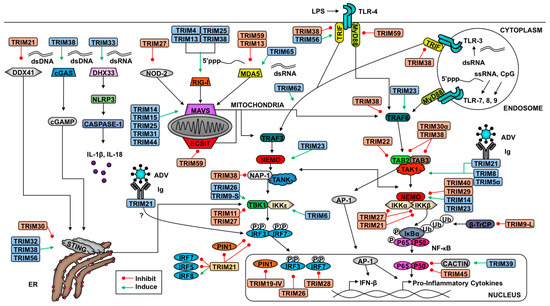
Kuva tässä linkissä osoittaa MAVS ja STING proteiinien sijainnin. MAVS on mitokondriaan assosioitunut ja STING endoplasmiseen retikulumiin. Niitten avulla solu lajittelee virusvihollisiaan.

” Antivirusimmuunivasteessa on tyypin 1 interferoni(IFN) signaalinvälittäjäna ja sen sanomana on, että solun virussensorijärjestelmä (DNA-sensori cGAS ja RNA-sensorit RIG-1 ja MDA5) ovat tunnistaneet DNA ja RNA virusta. Näiden DNA ja RNA-sensoreiden aktivoituminen johtaa STING- ja vastaavasti MAVS- proteiinien rekrytoitumiseen- ja nämä herätteet konvergoituvat TBK1- signalointitiehen ja siitä seuraa IRF3- fosforyloituminen ( ja aktivoituminen) ja 1 tyypin IFN:n tuotto ( katso kuva)

  • Type I interferon (IFN) is an important component of antiviral innate immune signaling mediated by viral DNA and RNA recognition by the DNA sensor cGAS and RNA sensors RIG-I and MDA5. Activation of these DNA and RNA sensors leads to the recruitment of STING and MAVS, respectively, and converges on TANK-binding kinase 1 (TBK1) signaling for subsequent phosphorylation of IFN regulatory factor 3 (IRF3).
(TANK= TRAF family member associated NfkB activator)
(TRAF = TNR receptor associated factor)
(TNR = tumor necrosis factor, proinflamamtorinen sytokiini)
(GSK3beta =glykogeenisyntaasikinaasi , 3 beta https://en.wikipedia.org/wiki/GSK-3, kiinnsotava entsyymi ja ilmenee monessa patologiassa)


”TBK1 kinaasin aktivaatio ei ole täysin yksityiskohtaisesti selvitetty. Tässä työssä on tunnistettu TRIM9 geenin koodaama lyhempi isoformi 1-tyypin interferonisignaloinnin positiiviseksi säätelijäksi. Virusinfektion aikana TRIM9 autopolyubikitinoituu K63 asemaan ja toimii alustana, jolla GSK3beta liittyy TBK1 entsyymiin ja tätä tietä pääsee IRF3-siganlointi aktivoitumaan. Tutkijat havaitsivat, että TRIM9 pystyy selektiivisesti inhiboimaan proinflammatoristen sytokiinien tuotantoa, mutta lisää 1- tyypin interferonin ja interferonilla stimuloituvien geenien ilmenemistä. Tutkijoitten löytönä on TRIM9:n kaksoisvaikutukset antivirusimmuniteetissä ja ne tasapainottavat proinflammatorisia vasteita ja 1- tyypin interferonien tuotantoa”.

  • However, the mechanisms that control TBK1 activation are still poorly defined. Here, we identify tripartite motif 9 short isoform (TRIM9s) as a positive regulator in type I IFN signaling. Upon viral infection, TRIM9s undergoes Lys-63-linked auto-polyubiquitination and serves as a platform to bridge GSK3β to TBK1, leading to the activation of IRF3 signaling. Interestingly, we found that TRIM9s selectively inhibits the production of pro-inflammatory cytokines, but enhances the expression of type I IFNs as well as IFN-stimulated genes, in response to viral infection. Our findings reveal novel dual functions of TRIM9s in antiviral immunity, which serve to balance pro-inflammatory response and production of type I IFNs.
  • TRIM9 pitempi isoformi 16-393X/5/3/23/htm

TRIM9 on aivospesifinen NF-kB:n negatiivinen säätelijä.

TRIM9 as a brain-specific negative regulator of the NF-κB pro-inflammatory signalling pathway.

E3 ubiquitin-protein ligase TRIM9 isoform 1 [Homo sapiens]

NCBI Reference Sequence: NP_055978.4
Identical Proteins FASTA Graphics
LOCUS       NP_055978                710 aa            linear   PRI 08-APR-2018
DEFINITION  E3 ubiquitin-protein ligase TRIM9 isoform 1 [Homo sapiens].
ACCESSION   NP_055978
VERSION     NP_055978.4
DBSOURCE    REFSEQ: accession NM_015163.5
KEYWORDS    RefSeq.
SOURCE      Homo sapiens (human)
  ORGANISM  Homo sapiens
            Eukaryota; Metazoa; Chordata; Craniata; Vertebrata; Euteleostomi;
            Mammalia; Eutheria; Euarchontoglires; Primates; Haplorrhini;
            Catarrhini; Hominidae; Homo.
REFERENCE   1  (residues 1 to 710)
  AUTHORS   Plooster M, Menon S, Winkle CC, Urbina FL, Monkiewicz C, Phend KD,
            Weinberg RJ and Gupton SL.
  TITLE     TRIM9-dependent ubiquitination of DCC constrains kinase signaling,
            exocytosis, and axon branching Extracellular netrin-1 and its receptor deleted in colorectal cancer (DCC) promote axon branching in developing cortical neurons.

  JOURNAL   Mol. Biol. Cell 28 (18), 2374-2385 (2017)
   PUBMED   28701345
  REMARK    GeneRIF: Authors demonstrate that tripartite motif protein 9
            (TRIM9)-dependent ubiquitination of DCC blocks the interaction with
            and phosphorylation of FAK.
REFERENCE   2  (residues 1 to 710)
  AUTHORS   Qin Y, Liu Q, Tian S, Xie W, Cui J and Wang RF.
  TITLE     TRIM9 short isoform preferentially promotes DNA and RNA
            virus-induced production of type I interferon by recruiting
            GSK3beta to TBK1
  JOURNAL   Cell Res. 26 (5), 613-628 (2016)
   PUBMED   26915459
  REMARK    GeneRIF: TRIM9s undergoes Lys-63-linked auto-polyubiquitination and
            serves as a platform to bridge GSK3beta to TBK1, leading to the
            activation of IRF3 signaling.
REFERENCE   3  (residues 1 to 710)
  AUTHORS   Yang X, Coulombe-Huntington J, Kang S, Sheynkman GM, Hao T,
            Richardson A, Sun S, Yang F, Shen YA, Murray RR, Spirohn K, Begg
            BE, Duran-Frigola M, MacWilliams A, Pevzner SJ, Zhong Q, Trigg SA,
            Tam S, Ghamsari L, Sahni N, Yi S, Rodriguez MD, Balcha D, Tan G,
            Costanzo M, Andrews B, Boone C, Zhou XJ, Salehi-Ashtiani K,
            Charloteaux B, Chen AA, Calderwood MA, Aloy P, Roth FP, Hill DE,
            Iakoucheva LM, Xia Y and Vidal M.
  TITLE     Widespread Expansion of Protein Interaction Capabilities by
            Alternative Splicing
  JOURNAL   Cell 164 (4), 805-817 (2016)
   PUBMED   26871637
REFERENCE   4  (residues 1 to 710)
  AUTHORS   Shi M, Cho H, Inn KS, Yang A, Zhao Z, Liang Q, Versteeg GA,
            Amini-Bavil-Olyaee S, Wong LY, Zlokovic BV, Park HS, Garcia-Sastre
            A and Jung JU.
  TITLE     Negative regulation of NF-kappaB activity by brain-specific
            TRIpartite Motif protein 9
  JOURNAL   Nat Commun 5, 4820 (2014)
   PUBMED   25190485
  REMARK    GeneRIF: TRIM9 is a brain-specific negative regulator of the
            NF-kappaB pro-inflammatory signalling pathway.
            Publication Status: Online-Only
REFERENCE   5  (residues 1 to 710)
  AUTHORS   Kanazawa T, Ikeda M, Glatt SJ, Tsutsumi A, Kikuyama H, Kawamura Y,
            Nishida N, Miyagawa T, Hashimoto R, Takeda M, Sasaki T, Tokunaga K,
            Koh J, Iwata N and Yoneda H.
  TITLE     Genome-wide association study of atypical psychosis
  JOURNAL   Am. J. Med. Genet. B Neuropsychiatr. Genet. 162B (7), 679-686
            (2013)
   PUBMED   24132900
REFERENCE   6  (residues 1 to 710)
  AUTHORS   Tanji K, Kamitani T, Mori F, Kakita A, Takahashi H and Wakabayashi
            K.
  TITLE     TRIM9, a novel brain-specific E3 ubiquitin ligase, is repressed in
            the brain of Parkinson's disease and dementia with Lewy bodies
  JOURNAL   Neurobiol. Dis. 38 (2), 210-218 (2010)
   PUBMED   20085810
  REMARK    GeneRIF: These results suggest that TRIM9 plays an important role
            in the regulation of neuronal functions and participates in
            pathological process of Lewy body disease through its ligase
            activity.
REFERENCE   7  (residues 1 to 710)
  AUTHORS   Li Y, Chin LS, Weigel C and Li L.
  TITLE     Spring, a novel RING finger protein that regulates synaptic vesicle
            exocytosis
  JOURNAL   J. Biol. Chem. 276 (44), 40824-40833 (2001)
   PUBMED   11524423
REFERENCE   8  (residues 1 to 710)
  AUTHORS   Reymond A, Meroni G, Fantozzi A, Merla G, Cairo S, Luzi L,
            Riganelli D, Zanaria E, Messali S, Cainarca S, Guffanti A, Minucci
            S, Pelicci PG and Ballabio A.
  TITLE     The tripartite motif family identifies cell compartments
  JOURNAL   EMBO J. 20 (9), 2140-2151 (2001)
   PUBMED   11331580
REFERENCE   9  (residues 1 to 710)
  AUTHORS   Ohara O, Nagase T, Ishikawa K, Nakajima D, Ohira M, Seki N and
            Nomura N.
  TITLE     Construction and characterization of human brain cDNA libraries
            suitable for analysis of cDNA clones encoding relatively large
            proteins
  JOURNAL   DNA Res. 4 (1), 53-59 (1997)
   PUBMED   9179496
REFERENCE   10 (residues 1 to 710)
  AUTHORS   Dawson SJ and White LA.
  TITLE     Treatment of Haemophilus aphrophilus endocarditis with
            ciprofloxacin
  JOURNAL   J. Infect. 24 (3), 317-320 (1992)
   PUBMED   1602151
COMMENT     REVIEWED REFSEQ: This record has been curated by NCBI staff. The
            reference sequence was derived from BC063872.1, DA101991.1,
            DA173440.1 and D87458.2.
            On Jun 13, 2008 this sequence version replaced NP_055978.3.
            
            Summary: The protein encoded by this gene is a member of the
            tripartite motif (TRIM) family. The TRIM motif includes three
            zinc-binding domains, a RING, a B-box type 1 and a B-box type 2,
            and a coiled-coil region. The protein localizes to cytoplasmic
            bodies. Its function has not been identified. Alternate splicing of
            this gene generates two transcript variants encoding different
            isoforms. [provided by RefSeq, Jul 2008].
            
            Transcript Variant: This variant (1) represents the longest
            transcript and encodes the longer isoform (1).
            
            Publication Note:  This RefSeq record includes a subset of the
            publications that are available for this gene. Please see the Gene
            record to access additional publications.
            
            ##Evidence-Data-START##
            Transcript exon combination :: BC063872.1, SRR1660807.103429.1
                                           [ECO:0000332]
            RNAseq introns              :: mixed/partial sample support
                                           SAMEA1965299, SAMEA1966682
                                           [ECO:0000350]
            ##Evidence-Data-END##
FEATURES             Location/Qualifiers
     source          1..710
                     /organism="Homo sapiens"
                     /db_xref="taxon:9606"
                     /chromosome="14"
                     /map="14q22.1"
     Protein         1..710
                     /product="E3 ubiquitin-protein ligase TRIM9 isoform 1"
                     /EC_number="2.3.2.27"
                     /note="homolog of rat RING finger Spring; tripartite
                     motif-containing protein 9; E3 ubiquitin-protein ligase
                     TRIM9; RING finger protein 91; RING-type E3 ubiquitin
                     transferase TRIM9"
                     /calculated_mol_wt=79046
     Region          9..>38
                     /region_name="RING"
                     /note="RING-finger (Really Interesting New Gene) domain, a
                     specialized type of Zn-finger of 40 to 60 residues that
                     binds two atoms of zinc; defined by the 'cross-brace'
                     motif C-X2-C-X(9-39)-C-X(1-3)-
                     H-X(2-3)-(N/C/H)-X2-C-X(4-48)C-X2-C; probably involved
                     in...; cd00162"
                     /db_xref="CDD:238093"
     Site            41
                     /site_type="phosphorylation"
                     /experiment="experimental evidence, no additional details
                     recorded"
                     /note="Phosphothreonine. {ECO:0000250|UniProtKB:Q8C7M3};
                     propagated from UniProtKB/Swiss-Prot (Q9C026.1)"
     Site            44
                     /site_type="phosphorylation"
                     /experiment="experimental evidence, no additional details
                     recorded"
                     /note="Phosphoserine. {ECO:0000250|UniProtKB:Q8C7M3};
                     propagated from UniProtKB/Swiss-Prot (Q9C026.1)"
     Site            46
                     /site_type="phosphorylation"
                     /experiment="experimental evidence, no additional details
                     recorded"
                     /note="Phosphoserine. {ECO:0000250|UniProtKB:Q8C7M3};
                     propagated from UniProtKB/Swiss-Prot (Q9C026.1)"
     Site            49
                     /site_type="phosphorylation"
                     /experiment="experimental evidence, no additional details
                     recorded"
                     /note="Phosphoserine. {ECO:0000250|UniProtKB:Q8C7M3};
                     propagated from UniProtKB/Swiss-Prot (Q9C026.1)"
     Region          163..211
                     /region_name="BBOX"
                     /note="B-Box-type zinc finger; smart00336"
                     /db_xref="CDD:197662"
     Region          224..266
                     /region_name="BBOX"
                     /note="B-Box-type zinc finger; smart00336"
                     /db_xref="CDD:197662"
     Region          273..399
                     /region_name="BBC"
                     /note="B-Box C-terminal domain; smart00502"
                     /db_xref="CDD:128778"
     Region          453..532
                     /region_name="FN3"
                     /note="Fibronectin type 3 domain; One of three types of
                     internal repeats found in the plasma protein fibronectin.
                     Its tenth fibronectin type III repeat contains an RGD cell
                     recognition sequence in a flexible loop between 2 strands.
                     Approximately 2% of all...; cd00063"
                     /db_xref="CDD:238020"
     Site            order(521..522,524..525)
                     /site_type="other"
                     /note="Cytokine receptor motif"
                     /db_xref="CDD:238020"
     Region          529..700
                     /region_name="SPRY_PRY_TRIM67_9"
                     /note="PRY/SPRY domain in tripartite motif-containing
                     proteins, TRIM9 and TRIM67; cd12889"
                     /db_xref="CDD:293947"
     CDS             1..710
                     /gene="TRIM9"
                     /gene_synonym="RNF91; SPRING"
                     /coded_by="NM_015163.5:766..2898"
                     /note="isoform 1 is encoded by transcript variant 1"
                     /db_xref="CCDS:CCDS9703.1"
                     /db_xref="GeneID:114088"
                     /db_xref="HGNC:HGNC:16288"
                     /db_xref="MIM:606555"
ORIGIN      
        1 meemeeelkc pvcgsfyrep iilpcshnlc qacarnilvq tpesespqsh raagsgvsdy
       61 dyldldkmsl yseadsgygs yggfasaptt pcqkspngvr vfppampppa thlspalapv
      121 prnscitcpq chrslilddr glrgfpknrv legvidryqq skaaalkcql cekapkeatv
      181 mceqcdvfyc dpcrlrchpp rgplakhrlv ppaqgrvsrr lsprkvstct dhelenhsmy
      241 cvqckmpvcy qcleegkhss hevkalgamw klhksqlsqa lnglsdrake akeflvqlrn
      301 mvqqiqensv efeaclvaqc dalidalnrr kaqllarvnk ehehklkvvr dqishctvkl
      361 rqttglmeyc levikendps gflqisdali rrvhltedqw gkgtltprmt tdfdlsldns
      421 pllqsihqld fvqvkasspv patpilqlee ccthnnsatl swkqpplstv padgyileld
      481 dgnggqfrev yvgketmctv dglhfnstyn arvkafnktg vspysktlvl qtsevawfaf
      541 dpgsahsdii lsndnltvtc ssyddrvvlg ktgfskgihy weltvdrydn hpdpafgvar
      601 mdvmkdvmlg kddkawamyv dnnrswfmhn nshtnrtegg itkgatigvl ldlnrknltf
      661 findeqqgpi afdnveglff pavslnrnvq vtlhtglpvp dfyssrasia